
Fibromyalgia and Weather…What Worsens Symptoms & What Helps
Home | Treatment & Research News

Many people with fibromyalgia are sensitive to heat and cold, but how does the weather affect their symptoms? Some patients report flare-ups when temperatures drop or storms move in. Although responses vary, research suggests that colder weather and lower barometric pressure can worsen certain fibromyalgia symptoms—and offers practical ways to reduce their impact.
A large population study supports what many patients already know: weather-related symptom changes are real. Other studies offer clues about why changing conditions can influence how you feel and point to practical steps that may help. Although you cannot control the forecast, you can prepare for conditions that tend to worsen your symptoms.
More Pain in Autumn?
Marco Di Carlo, M.D., Ph.D., and his team in Italy used a large population database to examine how weather affects fibromyalgia symptoms.1 They evaluated patients during four different seasons and excluded those with other weather-sensitive conditions, such as arthritis. This approach helped the researchers focus specifically on fibromyalgia rather than pain in general.
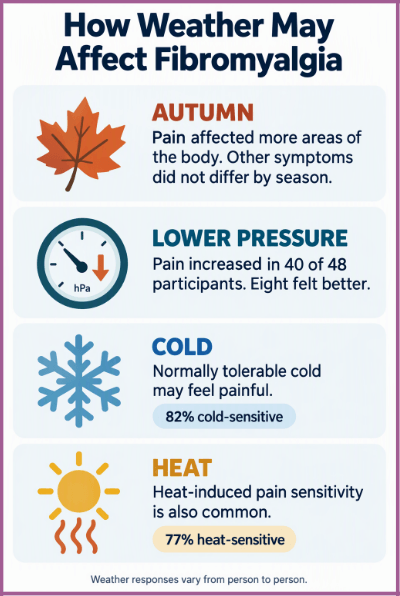
Di Carlo found that fibromyalgia symptoms were worse in autumn, while patients felt their best during summer. In particular, patients reported pain in more areas of the body during autumn than during the warmer summer months. Researchers measure this symptom with the widespread pain index, or WPI But did these seasonal fibromyalgia flare-ups involve symptoms other than widespread pain?
The researchers found no seasonal differences in their general assessments of sleep, fatigue, brain fog, anxiety, or depression.
What do these findings mean for you? Di Carlo recommends letting patients know that widespread pain may worsen during autumn. You can track changes in your WPI using the diagram on our diagnostic criteria page. However, weather-related fibromyalgia pain varies from person to person. Your symptoms may worsen in winter or when a cold front moves into your area instead.
Di Carlo also suggests talking with your doctor about seasonal medication adjustments, especially if your WPI score begins to rise. Adjusting treatment before or during autumn may help prevent or reduce flare-ups.
Barometric Pressure
How does barometric pressure affect fibromyalgia symptoms? Tropical storms and cold fronts reduce barometric pressure and occur most often during autumn. In a small study of 48 fibromyalgia patients, lower pressure increased pain intensity and unpleasantness in 40 participants.2 However, the remaining eight had the opposite response: they felt better when pressure was lower and humidity was higher.
This study confirms that people with fibromyalgia do not all respond to weather changes in the same way. Individual differences may also explain why a minority of patients feel better in cold weather rather than hot weather.
Why might barometric pressure affect your symptoms? One possible explanation involves the high rate of sleep-disordered breathing among people with fibromyalgia. Unlike insomnia, these breathing-related sleep disruptions often go unnoticed and may worsen when barometric pressure drops.3 Repeated interruptions throughout the night can increase pain sensitivity and intensify symptoms.
Temperature Sensitivities
Patients are much more sensitive than healthy individuals to cold applied to the skin. This fibromyalgia temperature sensitivity can involve both cold and head. Across multiple studies, 82% of patients were sensitive to cold-induced pain, while 77% were sensitive to heat-induced pain.4 For some patients, even normally tolerable cold temperatures can feel painful.
Richard Berwick, M.D., of the United Kingdom, examined why weather changes—especially exposure to cold—may trigger fibromyalgia flare-ups. He concluded that two overlapping mechanisms may contribute: abnormal blood flow through the tissues and altered regulation of body temperature.
Altered Thermal Regulation
Amino acids in the blood help regulate body temperature, a process called thermoregulation. As outdoor temperatures change, your body maintains a stable core temperature by shifting blood flow between the trunk and the extremities. If this system does not work properly, changes in the weather may affect you more strongly.
Antonia Casas-Barragan, Ph.D., and colleagues in Spain measured hand and core body temperatures in nearly 50 people with fibromyalgia and a matched group of healthy controls.5 At the same time, the researchers measured blood concentrations of amino acids to look for relationships with body temperature.
In the healthy group, only one amino acid was associated with core or hand temperature. In the patient group, several amino acids were associated with body temperature. Casas-Barragan said this difference may indicate that temperature regulation in fibromyalgia differs from that in healthy individuals. Serine and lysine, which are elevated in patients, have also been linked to hypothermia and hypothyroidism—conditions that can cause muscle pain and fatigue.
While more research is needed, the amino acid abnormalities may help explain why cold weather triggers fibromyalgia flare-ups. Aerobic activities that improve circulation and generate heat may help your body respond better to cold.
Summertime Benefits
“During the summer, increased sun exposure leads to elevated levels of serotonin and vitamin D, both of which are known to positively influence pain perception,” says Di Carlo. He adds that summer promotes physical activity, which improves circulation to achy muscles.
Summer and spring make it easier to swim, garden, walk, play outdoors with your children or grandchildren, or spend time with neighbors. These activities keep your body moving and your mind engaged, which can help you manage fibromyalgia. But this is not to say that warm weather improves depression or anxiety, because Di Carlo did not find these two symptoms were affected by the season.
You may not be able to recreate summer weather, but you can carry some of its benefits into the colder months. Ask your doctor whether you need a vitamin D supplement, and plan cold-weather activities to replace the ones you enjoy in summer. If you head outdoors, bundle up to maintain circulation to sore muscles. On especially cold days, choose indoor activities that keep you moving.
What You Can Do
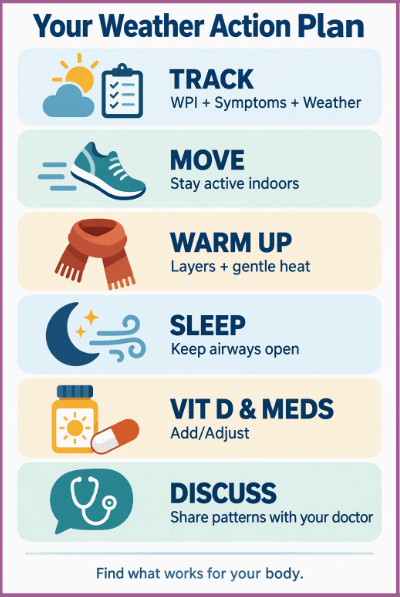
Track your WPI along with your symptom severity score, which measures sleep, fatigue, and brain fog and is explained on our diagnostic criteria page. Documenting how your symptoms change with the weather validates your experience and gives you specific information to discuss with your doctor. As you learn which strategies help and your WPI improves, you will gain confidence in your ability to weather fibromyalgia flare-ups.
Ask your doctor whether you need a vitamin D3 supplement and how often your blood levels should be checked. Also, replace the activities you enjoy in summer with options that keep you moving during colder weather.
Help your temperature-control system work more efficiently by reducing heat loss and supporting circulation. Wear thermal socks at night and layered clothing during the day. Heated blankets, warm showers or baths, hot tubs, and heat wraps may also help limit shivering and ease the effects of cold weather.
Keep your nasal passages open at night with measures such as nasal irrigation. If you snore or have other signs of disrupted breathing during sleep, ask your doctor whether you should be evaluated for sleep apnea.
Don’t Miss a Beat on New Treatments & Research: Sign up for a Free Membership today.
Research holds the key to better treatments. AFSA funded eight projects since June 2024; help us fund more!
WPI-Symptom Tracking | Symptoms | Medications | Managing Pain
Fibromyalgia and Weather References
- Di Carlo M, et al. Clin Rheumatol 44(11):4671-4679, 2025. Free Report
- Fagerlund AJ, et al. PLOS ONE 14(5):e0216902, 2019. Free Report
- Doherty MJ, et al. J Clin Sleep Med 6(2):152-156, 2010. Free Report
- Berwick RJ, et al. J Pain 22(5):473-486, 2021. Free Report
- Casas-Barragan A, et al. Int J Mol Sci 25(24):13517, 2024. Free Report