
Considering a New Med?
FDA-approval doesn’t mean “best in show”
by Alan Spanos, M.D., Chapel Hill, NC

Fibromyalgia produces a variety of symptoms and there are more than 100 medications to treat them. You are not limited to those FDA-approved for fibromyalgia (pregabalin, duloxetine and Savella). And there are no clear-cut ways for doctors to predict how a drug will work for you, so how do you narrow down the list? One way is to participate in your own individual treatment trials to determine which medications work best.
Some of the comments in this article may confirm your gut feelings about new and existing medications. Hopefully, the advice given will help you fend off the urge to try new drugs the moment they hit the prescription market.
‛New’ Doesn’t Mean ‛Better’
We don’t know whether the newer fibromyalgia medications do better than the older generics. When the FDA labels a drug as “indicated for fibromyalgia,” it doesn’t mean it’s better or more powerful than older medications. In fact, it may have only a marginal effect on a few patients. Based on that, it can still pass the FDA tests and be labeled “effective in fibromyalgia.”
Most drugs used for fibromyalgia are generics, i.e. they can be made cheaply by any number of manufacturers. But drug companies naturally want the FDA’s seal of approval on their newly patented product. To get this, they must present evidence that it’s “effective.” However, it doesn’t have to be better than already available medications.
Putting the FDA approval label into perspective, these medications only need to outperform a sugar pill (placebo) and not by a wide margin. The benefit might be minuscule, but it still earns the FDA label “effective for treatment of fibromyalgia.”
The FDA’s definition of effective is probably not what this word means to you. For instance, if a fabric cleaner was touted as “effective for removing fruit stains,” you would expect it to remove most fruit stains from most fabrics. But the three FDA-approved fibromyalgia medications don’t remove fibromyalgia symptoms from most people. Studies show they reduce one or two symptoms a bit, for a while, in a minority of patients.
The drug company may trumpet the fact that its product is “effective in 50 percent of cases.” But this claim can be misleading to patients if the placebo did just as well for 35 percent. In other words, only 15 percent (the difference between 50 and 35) did better taking the drug compared to the sugar pill.
Big Responders
Despite the gloomy statistics, a few people get a sizeable benefit from some drugs. In a large fibromyalgia patient survey, 10 to 15 percent indicated that one of the three FDA-approved medications helped them in a major way. Doctors would like to know more about these big responders, but they are not studied. As a result, we don’t know if they share certain features that might predict greater success with a given medication.
Doubts about New Drug Trials
The drug trials that are sent to the FDA do not include people with severe fibromyalgia. People who have more than one diagnosis don’t get into the trial either. And generally, patients must stop all their usual medications before starting the study. People with severe symptoms are virtually guaranteed not to enroll, because they run thew risk of feeling worse on a placebo. Putting this into perspective, the modest benefits claimed by drug companies pertain to patients with mild symptoms.
Not only are the severe cases of fibromyalgia eliminated by the selection process, but also there are problems with bias. Any doctor who participates in such trials quickly discovers they can tilt the results in favor of the test drug. And since it is the drug manufacturers who carry out the studies, one can assume bias occurs.
For the reasons above, Marcia Angell, M.D., retired editor of the New England Journal of Medicine, wrote, “It is simply no longer possible to believe much of the clinical research that is published.” *
So What Should I Try?
If the data on newer fibromyalgia drugs are misleading and there of dozens of older alternatives, how can you or your doctor sort of what you should try? A common approach is to test just one drug from each chemically defined group (or drug class). If it doesn’t work, you ignore the others in the group. For instance, if gabapentin didn’t work, you would avoid pregabalin because they are chemically similar. Unfortunately, this simplified strategy doesn’t always work.
Quite frequently, a patient responds very well to one drug but not at all to other closely related ones. And the reverse is just as common. One drug in a class may cause unpleasant side effects, while its relatives in the same class might not.
Examples of drugs that are chemically similar, but may have very different effects in some patients, include the “SSRIs” fluoxetine, sertraline, and paroxetine; the sleep enhancers zolpidem and eszopiclone; the benzodiazepines clonazepam or alprazolam; and opioids like morphine or oxycodone.
Your Own Clinical Trial
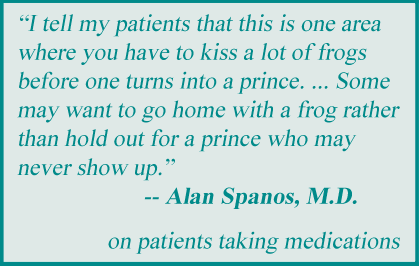
You need to try several different medications before finding one or two that help. I tell my patients that this is one area where you have to kiss a lot of frogs before one turns into a prince. The important thing is to try each medication properly. This involves using an adequate dose, for long enough to tell what it’s doing but no longer. Then move on to the next candidate and avoid staying on a drug without establishing whether it helps.
The take-home message for fibromyalgia patients is that they shouldn’t get too cranked up about the latest wonder drug. There is no medication for fibromyalgia that benefits 50 percent of patients. So, most medications probably won’t work, just as most times you throw a dice, it won’t come up with a six. But if you throw several dice in quick succession, the chance of getting a six is quite good.
To find out which medications work for you, try only one new drug at a time. The trial period may be a few days or a month. It depends on how long the drug takes to work, whether the dose must be increased gradually to minimize side effects, and so on. For drugs that take weeks to assess, patients should keep notes in a symptom diary.
Many patients want to try several different treatments for various symptoms: pain, fatigue, poor sleep, etc. Others quickly get tired of the process. They want to stop and settle on something, even though there might be a better medication. Some may want to go home with a frog rather than hold out for a prince who may never show up. We should respect patients’ choices.
Don’t Miss a Beat on New Treatments & Research: Sign up for a Free Membership today.
References
Dr. Alan Spanos has specialized in the treatment of difficult chronic pain including fibromyalgia and chronic fatigue syndrome/ME since 1986. He is trained in internal medicine, family practice, anesthesiology, acupuncture, clinical hypnosis, and myofascial pain. Spanos taught at several prestigious medical schools and hospitals nationwide. He is retired from his practice in Chapel Hill, NC.
* The Truth About the Drug Companies: How They Deceive Us and What to Do About It, by Marcia Engell, M.D. ISBN-10: 0375760946. Available on Amazon for $10.