
Fatigue in Fibromyalgia
Causes & Treatments

The fatigue in fibromyalgia is more than being tired. This symptom isn’t relieved by rest and the profound sense of exhaustion makes getting through the day difficult. While distraction therapies will help you cope with the pain, it’s impossible to push through the brick wall of fatigue. You need an arsenal of treatments to curb the multiple causes of your fibromyalgia exhaustion.
Despite fibromyalgia’s disabling potential, only a handful of research reports investigate what causes fatigue in this disease. And when it comes to treatments, the number of studies addressing your overwhelming lack of endurance are sparse. Fortunately, three physicians offer treatment advice based on their clinical experience with fibromyalgia and the approaches used for other fatiguing conditions.
Before delving into what causes your fatigue and possible treatments, it’s important to understand the scope of this symptom. Otherwise, you (or the people around you) will falsely assume that improving sleep and reducing stress will correct your worn-out state. These measures help, but it takes much more to knock down this symptom.
Nature of the Beast
Unpredictable, Uncontrollable, Unseen, and Unintelligible – these are the four adjectives (the 4 U’s) used by a research team in Spain to describe your fatigue.1 The unpredictable nature leaves you second-guessing your ability to plan a social life. You can sleep for days with fibromyalgia and still be exhausted because it’s uncontrollable. Your mental drain is invisible (unseen). And making matters worse, everyone thinks you are sandbagging your fatigue because they cannot comprehend its severity (unintelligible).
Your body feels heavy, your muscles feel weak, and everything requires more effort than you have to give. The weight of your fatigue can, at times, feel crushing. Difficulty thinking, making decisions, or getting motivated are other challenges related to being mentally spent. It’s as though your mind and body are stuck in a thick fog.
Causes of Fatigue
Although your muscles feel powerless, your zapped state is mostly due to alterations in the central nervous system. This includes changes in the brain as well as modifications in the way your nervous system interprets fatigue-related signals. Sleep and hormones that regulate your body’s sleep-wake rhythms also appear disrupted. In addition, your muscles do not work as efficiently as they should, so they wear out faster.
Brain Function – Greater reductions in gray matter volume in the thalamus are associated with increased fatigue severity.2 The thalamus is a brain region that interprets sensory information and filters out unimportant information. A decreased volume of the thalamus can impair its sensory filtering abilities. As a result, excessive information overload in the brain leads to the sensation of fatigue as well as enhanced pain. In a separate brain imaging study, the degree of immune cell activation (i.e., the microglia) correlated with fatigue in fibromyalgia patients.3
Sensory Pathways – Sensory messages from your body’s tissues, such as your working muscles, are transmitted to your spinal cord. In response, your cord sends the essential messages up to your brain for interpretation, leading to a response that is conveyed to the muscles. A dysfunction in this communication loop contributes to a heightened sense of lethargy or heaviness as well as muscle weakness.4 In other words, your nervous system interprets activities as more strenuous and tells your working muscles to slow it down. It makes a walk through the grocery store feel like you ran a marathon.
Sleep Disruption – Ordinarily, a good night’s sleep erases a healthy person’s fatigue. But if you are like most fibromyalgia patients, your sleep is light and unrefreshing. In addition, other sleep disorders commonly occur. Restless leg syndrome and obstructive sleep apnea are each present in one out of five patients, although apnea may be double that in male patients. Targeting these conditions and striving to get eight hours of sleep each night does help, but it’s not enough to reverse your energy drain.
Body Rhythm Shifts – Melatonin spikes at bedtime and drops to insignificant levels in the early morning. This hormone sets your body’s sleep-wake cycle, as well as your other body rhythms, but its secretion pattern is abnormal in fibromyalgia patients.5 You don’t secrete enough at bedtime and the levels are relatively high during the day. The result is a jet-lagged feeling that compounds your fatigue. See Hormonal Fatigue for more details.
Muscle Fatigue – Although the brunt of your exhaustion is due to malfunctions in the above systems, your muscles work inefficiently.6 They don’t operate in a coordinated fashion and they fail to fully relax between contractions. As a result, your muscles plow through more fuel. This dysfunction is partly due to myofascial trigger points (painful muscle knots); see Muscle Fatigue & Stiffness for details.
Medication Strategies
Medication trials for fibromyalgia rarely focus on treatments for your exhaustion, but there are drugs to ease it. According to Matthias Karst, M.D., of Hannover, Germany, “Fatigue may be similar in its expression between different diseases such as fibromyalgia, cancer, long-COVID, and chronic fatigue syndrome (CFS/ME). Therefore, treatment approaches for this symptom should also be similar.” Indeed, Anna Woodbury, M.D., of Emory University in Atlanta, agrees that physicians must draw on the clinical trial data for other lethargy-inducing disorders.
Another factor to keep in mind: “Fatigue is highly correlated with pain,” says Amir Minerbi, M.D., Ph.D., of Haifa, Israel. Consequently, Minerbi adds, “Improvements in fatigue often coincide with reduced pain severity.” This may be due to the shared sensory pathways for generating these two symptoms. As a result, aggressively reducing pain can make you feel more rejuvenated. However, Minerbi comments, “Fatigue is often overlooked when we focus on pain.”
“Methylphenidate has the most profound and obvious effect in my fibromyalgia patients,” says Woodbury. The change can be like day and night. Minerbi also prescribes stimulants like methylphenidate. In addition, he sometimes finds modafinil or armodafinil beneficial, and they are less regulated.
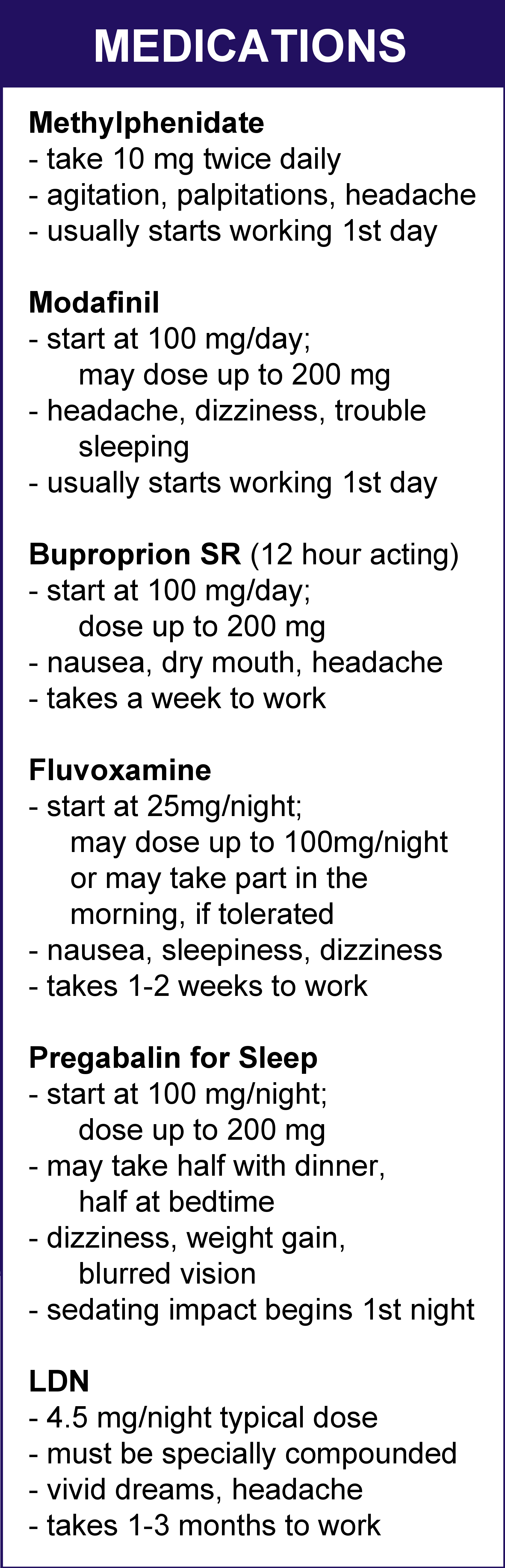 “Independently of the indication for depression,” says Karst, “I have good experience with buproprion.” Other activating antidepressants that he finds helpful are duloxetine, Savella, and fluvoxamine. The first two raise both serotonin and norepinephrine, and it is the impact on norepinephrine that is activating. On the other hand, fluvoxamine only increases serotonin, but the drug possesses a unique anti-inflammatory property to ease fatigue.
A brief rundown of energy-enhancing drugs is given below. In addition, see the table on Medications for dosing and primary side effects. As a rule of thumb, if you incur side effects, ask your doctor about cutting the dose to see if they remit.
Energizing Meds
Stimulants – Methylphenidate (Ritalin) treats attention deficits in children. It increases activating chemicals dopamine and norepinephrine in the brain. As a result, methylphenidate enhances alertness, but the downside of stimulants (including Adderall) is that they are regulated Schedule II drugs. Stimulants can potentially ease brain fog in one out of three patients and lift generalized fatigue in 20 percent of patients.7
Modafinil/armodafinil – These two cousin drugs were developed to treat narcolepsy, which causes daytime sleep attacks. Both meds promote wakefulness by increasing dopamine and norepinephrine. But unlike stimulants, they target only a few centers in the brain. The two drugs have a low addiction potential and are less regulated (Schedule IV drugs). Armodafinil is a longer lasting formulation of modafinil. Similar to stimulants, these medications are more likely to improve cognition than fatigue.8
Activating Antidepressants – Buproprion increases norepinephrine and dopamine in the brain (to a lesser extent than the medications above). The 12-hour acting “SR” version is best for minimizing sleep disruption. Savella (milnacipran) and duloxetine both increase serotonin and norepinephrine. Savella exerts a greater impact on norepinephrine and it’s more likely to trim fatigue than duloxetine. Fluvoxamine, another antidepressant, can also minimize your sense of exhaustion by chilling out your immune system. None of these medications are regulated drugs.
Sleep Meds – “Pregabalin helps some of my fibromyalgia patients with sleep when taken in the evening, which can subsequently improve fatigue,” says Woodbury. Minerbi agrees and prescribes gabapentin as an alternative but cautions that daytime use might increase fatigue. Both medications treat restless leg syndrome and can counter the lingering effects of daytime energizers. Other helpful sleep agents are cyclobenzaprine, doxepin, and trazodone.
Low-Dose Naltrexone (LDN) – “Some of my patients have success with LDN for easing fatigue,” says Karst. It’s thought to reduce microglia cell activation in the brain.
Alternative Therapies
For Fibromyalgia Fatigue
Many approaches can add more pep in your day. Some are self-help measures that don’t cost anything, while others can be pricey.
 Lifestyle Changes – Move more ergonomically to consume less energy and reduce muscle strain. For example, minimize working with your arms extended, use lots of support pillows, and breath, breath, breath. Reduce stress with the aid of a free online course by the University of Michigan called PainGuide. And even on days when you don’t have the energy reserves for a workout, try to get up and move each hour. Above all, pace yourself and don’t overachieve on good days.
Nutrition – Avoid sugar “pick-me-ups” because they will cause your energy level to plummet one hour later. Instead, eat protein throughout the day and drink plenty of water. Minerbi recommends a diet low in processed foods and simple carbohydrates.
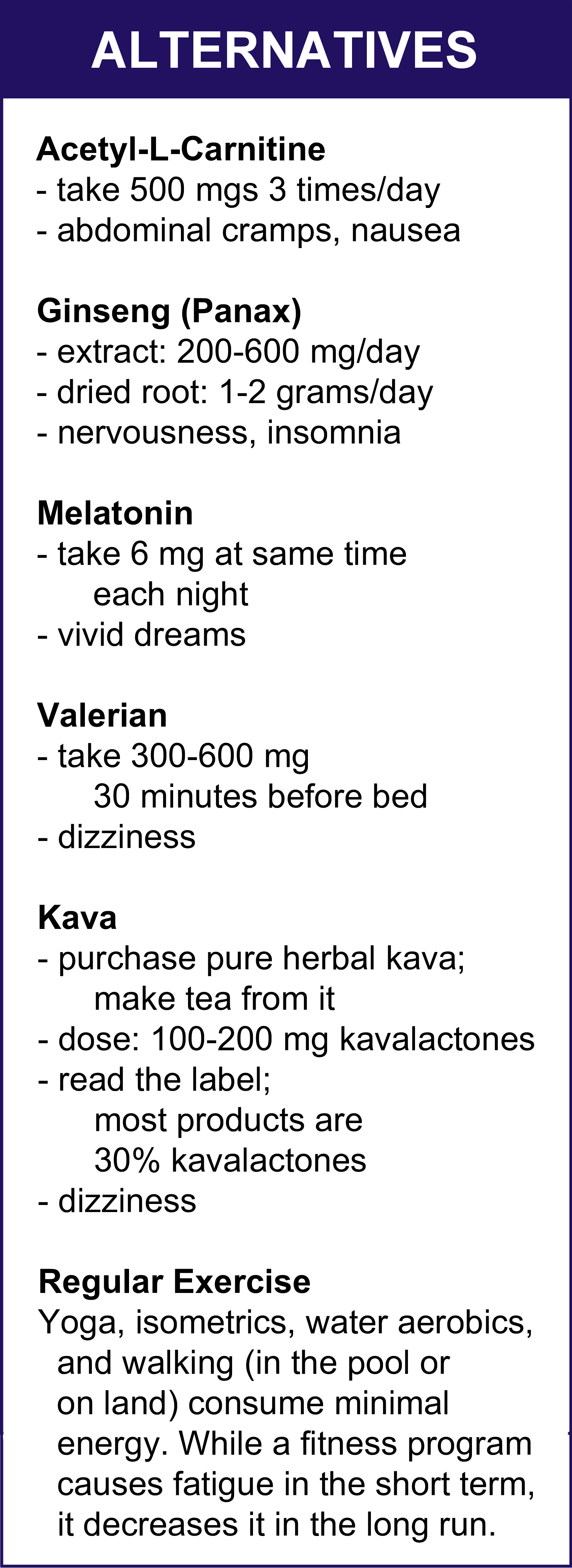
Supplements – Karst recommends two supplements for more stamina: Ginseng and Acetyl-L-Carnitine. Woodbury suggests the following sleep aids with the end goal of relieving fatigue: melatonin, valerian and kava. Although prescriptions aren’t required, consult your doctor before taking any supplement.
Cranial Electrical Stimulation (CES) – An Alpha-Stim CES device is an FDA-approved therapy for insomnia and anxiety. The device may rock you to sleep but it will set you back $840 unless you are a Veteran. Fortunately, the side effects are mild.
Massage Therapy – The goal of this therapy is twofold: working out painful knots in your muscles (myofascial trigger points) and improving circulation. A one-month study in fibromyalgia patients shows it improves fatigue and sleep, in addition to muscle discomfort.9 Biweekly, 15-minute treatments focusing on the neck/shoulder area is all you need.
Acupuncture – Woodbury recommends a specific type of acupuncture called Mega Mu Shu that’s invigorating. Check to see if your health insurance covers acupuncture.
Other Factors
Don’t assume all your fatigue is due to your fibromyalgia. “It’s very important to check for detectable factors that cause fatigue, such as anemia, depression, or a pain flare up,” says Karst. He also checks his patients for the MTHFR-polymorphism, which can compound fatigue and impair cognition. It’s a genetic variant that affects the body’s ability to process folate (or vitamin B9). Iron supplements treat the anemia and B-vitamins plus methylfolate treat the MTHFR gene mutation.
Other nutritional deficiencies that exacerbate your exhaustion are vitamin D and magnesium. “Low vitamin D contributes to musculoskeletal pain, depression, fatigue, and colon cancer,” says Woodbury. Reduced body stores of magnesium enhance muscle weakness and fatigue, but blood levels are misleading. As a result, supplementing with 500 mg/day is worth a try. In addition, Woodbury says, “Some of my patients like using magnesium sprays over their muscles.” The point is, other causes of fatigue in fibromyalgia patients require treatment.
AFSA funded six projects in 2024 and 2025 to test new treatments and better understand what causes your symptoms. Help us fund more projects in 2026.
Stay Current on Treatments & Research News: Sign up for a Free Membership today.
References Fatigue in Fibromyalgia
- Velsaco-Furlong L, et al. Int J Environ Res Public Heath 17:6224, 2020. Free Report
- Liu HY, et al. Clin Exp Rheum 41:1230-1237, 2023. Free Report
- Albrecht DS, et al. Brain Behav Immun 75:72-83, 2019. Free Report
- Zambolin F, et al. PLOS ONE 17(10):e0276009, 2022. Free Report
- Caumo W, et al. J Pain Res 12:545-556, 2019. Free Report
- Ibarra JM, Ge HY, et al. J Pain 12(12):1282-88, 2011. Free Report
- Blockmans D, Persoons P. Acta Clinica Belgica 71(6):407-414, 2016. Abstract
- Garg H, et al. BMJ Case Rep 14:e240283, 2021. Free Report
- Nadal-Nicolas Y, et al. Int J Environ Public Health 17:4611, 2021. Free Report