
Inflammation in Fibromyalgia
—Whole-Body PET Study
Principal Investigator: Marco Loggia, Ph.D.
Massachusetts General Hospital, USA

Fibromyalgia is often described as a problem with how neurons in the central nervous system (CNS) process pain. But neurons may not be acting alone. Immune cells in the CNS, known as glial cells, also appear to become activated and release inflammatory substances. With AFSA funding, Loggia is studying whether inflammation outside the CNS—in muscles and other tissues—helps drive widespread pain in fibromyalgia.
Standard blood tests do not show clear signs of inflammation in people with fibromyalgia. And even if they did, blood tests cannot pinpoint which tissues are inflamed. This AFSA-funded project uses whole-body imaging with a special marker to detect inflammation-related cellular distress signals that regular testing misses.
Detecting Inflammation
Loggia’s team was the first to document brain inflammation in people with fibromyalgia.1 He used PET (positron emission tomography) imaging to measure levels of TSPO, a protein marker found on immune cells when they respond to inflammation. Higher TSPO levels point to more inflammation in an area and show up as illuminated dots on the PET scan.
So far, imaging studies in fibromyalgia have mostly looked at the brain, leaving key questions unanswered. What is happening with immune cells elsewhere in the body? And could activated immune cells outside the CNS help keep pain processing in the brain stuck on high alert?
To answer these questions, Loggia is using TSPO to detect signs of inflammation. Instead of imaging only the brain, he is using a PET scanner that examines the whole body at once. Only a few whole-body PET machines exist worldwide.
“TSPO is expressed not only on the glial cells in the central nervous system but also on peripheral immune cells,” says Loggia. “This makes it, at least in principle, a promising marker of inflammation throughout the entire body.”
Not Just the Brain
Researchers typically use TSPO-PET to detect brain inflammation, but they can also apply it to tissues outside the brain. In fact, Loggia has already shown that TSPO-PET can sensitively measure inflammation in the knee joints of people with osteoarthritis.2
In those osteoarthritis patients, the TSPO signal matched disease severity better than standard X-rays did. “This suggests TSPO is sensitive to picking up disease relevant biology that conventional imaging may miss,” says Loggia.
Even more important, TSPO levels matched patients’ pain and blood cytokine levels. Cytokines are substances immune cells release when they respond to inflammation. This gives more evidence that TSPO can detect peripheral inflammation, even when standard blood tests look normal.
Fibromyalgia and osteoarthritis are very different conditions, but both can cause pain in peripheral tissues despite normal blood work. Loggia’s finding that TSPO measures inflammation and pain in osteoarthritis suggests it may also help assess fibromyalgia.
Loggia also tested his TSPO-PET idea in one person with fibromyalgia, and the results were encouraging. However, he needs to scan many more patients before he can draw conclusions.
Skull Bone Marrow
Bone marrow is the soft, spongy tissue inside bones that makes blood cells, including cells involved in inflammation. Recently, Loggia’s collaborators at Mass General Hospital found an interesting feature of skull bone marrow that may help explain what happens in fibromyalgia.
Skull bone marrow has tiny channels that allow immune cells to travel from the marrow to the brain. Once there, these immune cells can enact an inflammatory response.
In fibromyalgia, the brain TSPO PET findings may be driven not only by the resident glial cells, but also by immune cells penetrating the brain from the periphery, including the skull bone marrow.
“The TSPO signal extends beyond the muscles and joints (sites of referred pain in fibromyalgia) to also include the skull bone marrow,” says Loggia. He has already found increased TSPO signals in this tissue in other painful conditions and expects similar findings in fibromyalgia.3
Inflammation & Pain Mapping
How do the brain and peripheral systems connect in fibromyalgia? Loggia will use whole-body imaging and digital pain maps to study that relationship. Do stronger TSPO signals match areas with more pain? And does bone marrow activation stay in the skull, or does it reflect a broader body-wide pattern?
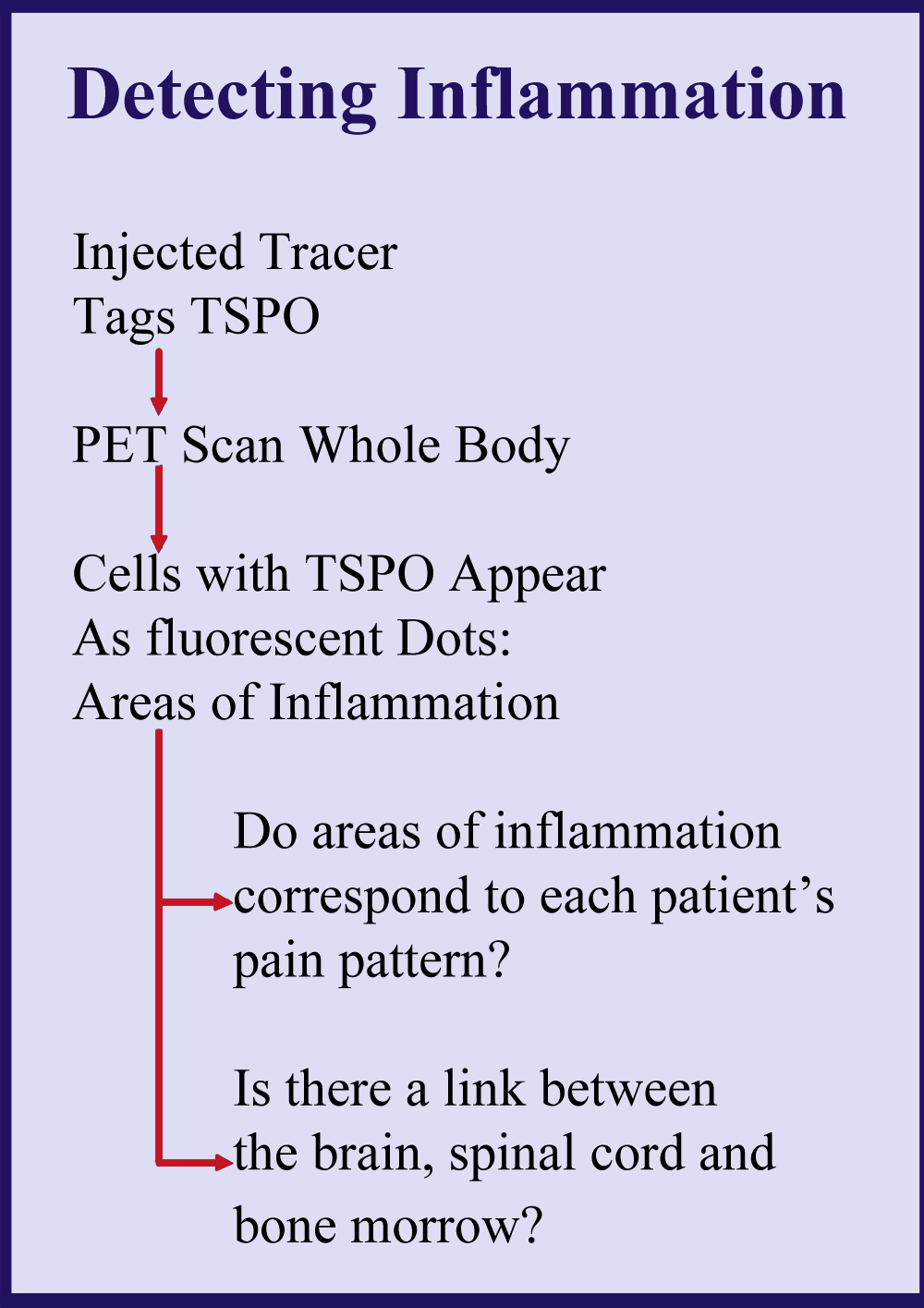
Although this is an early study, Loggia will look for inflammatory links between the brain, spinal cord, and bone marrow. The results may help explain where fibromyalgia pain comes from and point toward better long-term treatments.
Project’s Potential
Fibromyalgia pain is widespread, and researchers have found many changes outside the brain. In muscles, they have found reduced capillary flow, fragmented DNA, and changes in mitochondria. They have also found body-wide metabolic changes, excess fat deposits in muscles, and damaged nerve fibers in the skin.
Multiple studies also show subtle immune changes, along with brain inflammation. “This project will extend our prior work on central mechanisms by providing additional evidence for a contributory role of peripheral inflammation in fibromyalgia,” says Loggia. AFSA funded this work to build evidence that may eventually lead to more effective care.
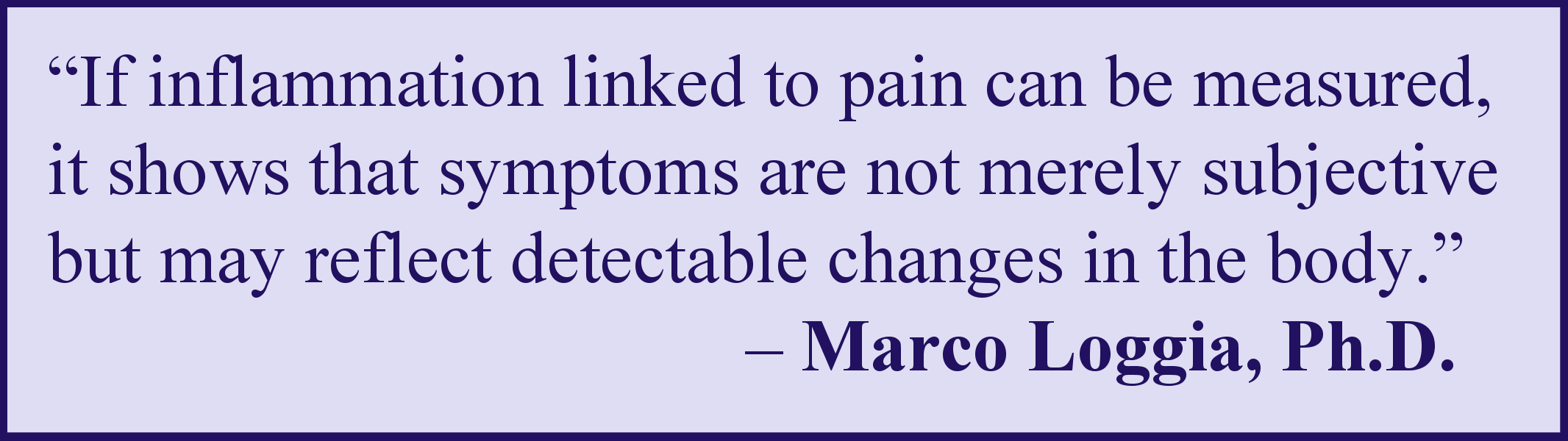
“This project could help reduce the stigma of fibromyalgia,” says Loggia. “If inflammation linked to pain can be measured, it shows that symptoms are not merely subjective but may reflect detectable changes in the body. It may also help identify patients who could benefit from treatments targeting inflammation outside the CNS.”
Although this AFSA-funded project is a small pilot study, it is an important step toward validating patients’ pain experiences. By looking for measurable signs of inflammation, Loggia’s work may lay the foundation for future treatments that offer more targeted, lasting relief.
Don’t Miss a Beat on New Treatments & Research: Sign up for a Free Membership today.
Research holds the key to better treatments. AFSA has funded eight projects since June of 2024. Help us keep the momentum going!
TSPO Marker | New Drug Tonmya | Alternative Therapies | Muscle Pain Relief
References for Inflammation in Fibromyalgia
- Albrecht DS, …, and Loggia ML. Brain Behav Immun 75:72-83, 2019. Free Report
- Sandstrom A, …, and Loggia ML. PAIN 165(5):1121-1130, 2024. Abstract
- Mohammadian M, …, and Loggia, ML. medRxIv Jul 21:2025.07.19.25331817, 2025. Free Report