
OTC Treatment for Fibromyalgia
… The Scoop on PEA Plus ALC
Home | Treatment & Research News

Injury and other painful circumstances prompt you to seek medical attention. With proper treatment, the discomfort goes away. But the cells that help resolve pain can become stuck in an activated mode, leading to neuroinflammation. Fortunately, fibromyalgia treatment trials show that two OTC supplements, palmitoylethanolamide (PEA) and acetyl-l-carnitine (ALC), can ease your pain.
Ibuprofen and aspirin do little, if any, to faze your muscle aches. That’s because treating neuroinflammation is more complicated and requires a different approach. But the ball is in your court because you can get PEA and ALC without the hassle of a prescription. So, even if your physician does not understand your fibromyalgia or how to treat it, you can still give this OTC approach a try.
What Goes Wrong
Your nervous system is chronically sending out pain alarms to make you hurt everywhere. And although the pain you feel is due to the constant firing of your neurons, it’s the nearby immune cells that are likely to blame. This leads to a state of neuroinflammation and it shows up on brain scans in fibromyalgia patients.
“Neuroinflammation involves a sea of immune and chemical mediators,” says Anthony Dickenson, Ph.D., at the University College in London.1 “It’s massively complicated.” You have changes in your peripheral systems (neurons and immune cells), which make your spinal cord neurons hyperexcitable. In turn, signals from your cord bombard your brain and it’s unable to get your pain under control.
Over time, the chemical reactants in your blood disrupt your blood-brain barrier. “Cells and other substances that could not normally enter the brain are now able to get in,” says Dickenson. This creates a threatening situation and leads to the activation of your glial cells (immune cells in the brain). When activated, they pump out nerve-irritating chemicals to cause more pain.
“The glial cells are trying to bring about a resolution; they are trying to solve the situation of an unhealthy brain environment,” says Dickenson. “As a consequence, they may contribute to your pain. But let’s not forget what they are really trying to do, which is fix the system that is out of control.”
In fibromyalgia, the glial cells are stuck in an activated state. Instead of resolving the malfunctions in your brain, chronically activated glial cells are part of the problem. They are partly responsible for maintaining your pain and other symptoms. If only you could take an OTC supplement to tame these cells and treat your fibromyalgia.
Tricky to Treat
Glial cells perform many essential functions. They nurture your neurons and protect your central nervous system against invading pathogens. They clear away harmful debris and work to cement cracks in the blood-brain barrier.
“Your glial cells can be involved in maladaptive mechanisms and play a role in pain generation,” says Dickenson. “But later, they can play a vital anti-inflammatory role to cause a resolution of the pain state.”
Completely shutting down glial cell activation could lead to bad consequences. “So, how can I treat this neuroinflammation?” asks Flaminia Coluzzi, M.D., of Sapienza University in Rome.1 Her fibromyalgia treatment approach involves an OTC supplement called palmitoylethanolamide (PEA).2
PEA tempers both mast cell and glial cell activation. Mast cells are present throughout your body, including your brain. During neuroinflammation, they become activated and dump chemical irritants into the surrounding tissues. This further activates your glial cells and a vicious cycle is set in motion.
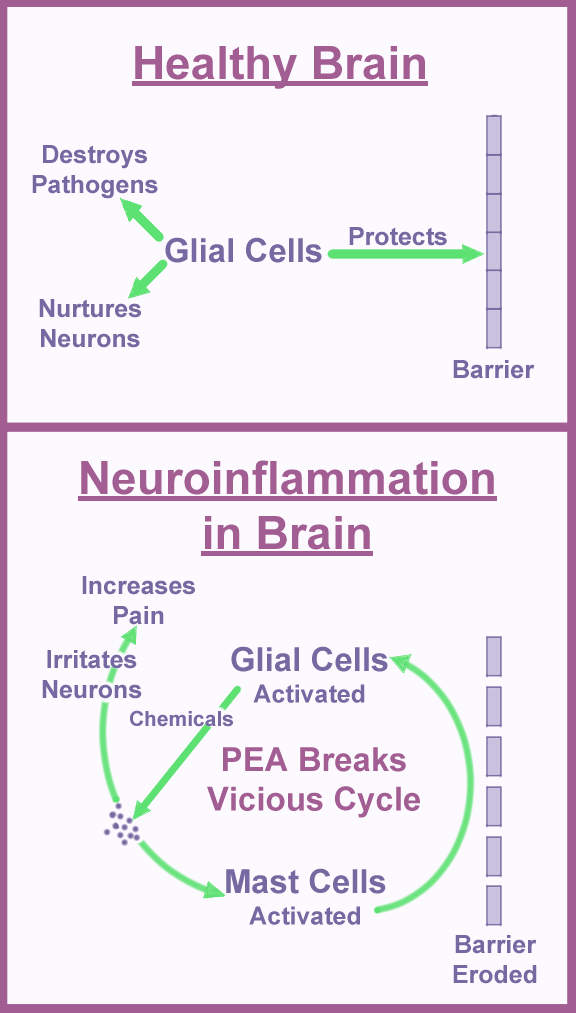
PEA helps break this cycle and it also reduces glial cell activation. But just as your glial cells perform vital functions, so do your mast cells. We don’t want to block their activity, we just want to restore these cells to their normal physiological function, explains Coluzzi.
PEA for Fibro
For fibromyalgia patients, PEA sounds like the ideal OTC treatment to relieve your pain. But what is the evidence that this supplement works?
“PEA is the most widely studied compound for modulating mast cell activation and restoring hyperactive glial cells to their physiological function,” says Coluzzi. It’s been tested in arthritis, low back pain (with sciatica), diabetic neuropathy, endometriosis, migraines, and fibromyalgia. The results are usually favorable, but most studies include only a small number of patients.
PEA takes time to provide symptom relief from pain. As a result, studies use it as an add-on to existing therapies. There are two treatment trials in fibromyalgia patients using PEA as an OTC supplement to ongoing care.3,4
The first study showed that adding PEA reduced the number of painful areas and decreased pain scores by 25%. The second study also showed PEA relieved pain and that the benefits were maintained for a 15-month study period.
Coluzzi tells her patients to give PEA a three-month trial to assess effectiveness. It takes time to get the neuroinflammation under control. At 600 mg/day, Coluzzi says, “There are no side effects.” However, double this dose is often used, which occasionally causes mild gastrointestinal irritation.
Adding ALC
Acetyl-L-Carnitine (ALC) is another OTC used in combination with PEA to treat fibromyalgia. It’s believed to relieve pain by reducing the release of pain transmitter, glutamate, from nerve endings. This minimizes the number of pain transmissions bombarding the central nervous system, while PEA helps restore glial cell function.
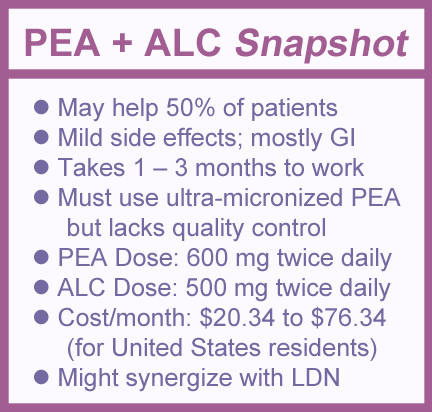
Three trials show that adding PEA+ALC to current treatments offers additional fibromyalgia symptom relief.5,6,7 A standard dose of 600 mg PEA and 500 mg ALC is taken twice daily. The side effects are mild and mostly related to the GI system.
The addition of the OTC supplements led to greater symptom improvements in all three studies. Unfortunately, the incremental benefit of adding ALC cannot be determined.
Wondering what your chances are of responding to PEA+ALC? One 24-month study indicates that 50% of patients respond favorably. The breakdown was 30% markedly improved and 20% somewhat improved. But keep in mind, these fibromyalgia patients were treated with medications and the OTC supplements by a team of experts.
Selecting PEA & ALC
PEA is a naturally occurring fatty acid and ALC is present in animal products. But you can’t get enough in your diet to impact your symptoms. You need to take OTC supplements.
“When we speak about PEA, one must consider what is on the market,” says Coluzzi. “You can find very different products. In its natural form, PEA is not absorbed by the gastrointestinal tract.” Coluzzi points out you must purchase PEA that has been ultra-micronized, which is a process that reduces the particle size to enhance absorption.
“The ultra-micronized PEA is 2,500 times smaller than the native PEA,” says Coluzzi. “Smaller is better.” It must be able to get into the brain. Unfortunately, nutraceuticals do not have the same regulatory oversight that medications do.
PEA supplement manufacturers will claim their product has undergone special processing to provide maximum GI absorption, but they will not list the particle size. All you can do is search for products that say “ultra-micronized” and hope they are telling you the truth. Also beware of products that just say “micronized” because the particle size is still 5-10 times too large.
Selecting ALC for treating your fibromyalgia is not as tricky as PEA. Just look for a product that contains 500 mg per capsule. Avoid higher doses because you run the risk of greater side effects without any proven benefits.
Products & Costs
Using OTC supplements to treat your fibromyalgia can be expensive, especially since you need to take PEA+ALC for a minimum of three months. Shoot for a dose of 600 mg PEA and 500 mg ALC taken twice daily. Chart your progress by notating your pain on a scale of 0 to 10 and your number of moderately painful areas.
If you are a responder to this therapy, but can’t continue for economic reasons, Coluzzi offers advice. After the first three months, she says patients may sometimes stop the supplements for a ten-day period every month. But you need to keep a symptom diary to determine if this cost-savings strategy works for you.
Finding ultra-micronized PEA is a challenge, but here are two options:
PEA PRO by Neurogan Health (90 capsules containing 500 mg each) available for $22 from Amazon. Although it is a slightly lower dose, it will probably do the job. Cost is $44 for a 3-month trial.
Pea Ultra with Levagen+ by Wellness Resources (60 capsules containing 300 mg each) available for $35 from Amazon. Levagen+ is a brand name of ultra-micronized PEA that was used in some of the clinical trials (especially in Australia). Cost is $210 for a 3-month trial.
ALC products are readily available and here are two options:
Acetyl-L-Carnitine by Carlyle (180 capsules containing 500 mg each) available for $17 from Amazon. This is a 3-month supply.
Acetyl-L-Carnitine by Nutricost (180 capsules containing 500 mg each) available for $19 from Amazon. This is a 3-month supply.
The total cost of a 3-month trial period to treat your fibromyalgia with these two OTC supplements will range between $61 and $229.
Potential Synergy
Low-dose naltrexone (LDN) is another treatment option for reducing glial cell activation. It works differently than PEA+ALC, so it could potentially produce synergistic effects. And not surprisingly, LDN also takes one to three months to show benefits. The cost for a three-month supply is comparable at $52 plus $4 shipping.
LDN has two downsides: It requires a doctor’s prescription and must be purchased from a compounding pharmacy. But the upside is that the drug is regulated by the FDA. Unlike PEA, you know exactly what you are getting.
Don’t Miss a Beat on New Treatments & Research: Sign up for a Free Membership today.
Research holds the key to better treatments. AFSA funded six projects in 2024 and 2025; help us fund more in 2026!
Symptoms | Medications | Alternative Therapies | Neuroinflammation Marker
References for OTC Treatments for Fibro
- Neuroinflammation-driven Chronic Pain, International Association for the Study of Pain meeting in Amsterdam, 2024.
- Coluzzi F, et al. Int J Mol Sci 26(24):11861, 2025. Free Report
- Del Giorno R, Skaper S, Paladini A. Pain Ther 4(2):169-178, 2015. Free Report
- Schweiger V, et al. CNS Neurol Disord Targets 18(4):326-333, 2019. Abstract
- Salaffi F, et al. Clin Exp Rheum 41(6):1323-1331, 2023. Free Report
- Salaffi F, et al. J Pers Med 14(7):689, 2024. Free Report
- Bentivenga C, et al. Pharmaceutics 17(8):1004, 2025. Free Report