
What is Fibromyalgia?
–A Serious Multi-System Disease

Invisible, unpredictable, frustrating, and often debilitating—that’s fibromyalgia. Its widespread symptoms seem to have no boundaries, and the disease robs you of restorative sleep. You wake up feeling as though the fibromyalgia monster spent the night punching and kicking you. Your muscles are stiff, your brain is foggy, and you’re exhausted before the day even begins.
Fibromyalgia affects every system in your body, yet standard lab tests rarely explain your long list of symptoms. You look fine but feel awful. Living with fibromyalgia is a daily struggle that others often cannot see.
Feels Like the Flu
Many people with fibromyalgia say it feels like a bad case of the flu that never goes away. Research supports the idea that fibromyalgia shares several features with a chronic viral illness.
When a virus invades your body, immune cells in your central nervous system spring into action to protect your brain. In the process, neurons send pain signals to muscles and other tissues. This nervous system response can cause fatigue, difficulty concentrating (brain fog), insomnia, and low mood—the same symptoms that often send you to bed with the flu.
Research shows that these immune cells remain unusually active in people with fibromyalgia. Instead of producing symptoms for only a few days, they appear to stay in an “enraged” state, creating a chronic pattern of flu-like symptoms.
Brain imaging studies funded by AFSA have documented increased activity of these immune cells in people with fibromyalgia. Standard blood tests cannot detect this activity because the cells reside within the central nervous system. Meanwhile, AFSA-funded research is investigating whether blood markers such as neutrophils and cytokines might help measure disease severity.
These findings suggest that fibromyalgia involves more than chronic pain. It alters the way the brain and body communicate.
Changes How Your Body Functions
Doctors often tell fibromyalgia patients that nothing is wrong because tests do not reveal tissue damage. Hearing this can be frustrating when you’re coping with so many symptoms. Yet the absence of tissue destruction may be good news. It suggests that researchers might eventually reverse the processes driving the disease.
Rather than damaging tissues, fibromyalgia changes how the brain and spinal cord function. This dysfunction affects the body’s ability to regulate many organ systems, including digestion, stress responses, and cardiovascular function. It’s as though signals entering the central nervous system become scrambled, leading to abnormal messages throughout the body.
Living with fibromyalgia can feel like having an unseen invader that resets your body’s controls. Your mind struggles to focus, your digestion becomes unpredictable, and blood flow to your muscles may be impaired. The slightest touch can hurt. Bright lights, sounds, and other sensory signals may feel overwhelming. Your coordination is off, your head pounds, and you feel decades older than you should.2
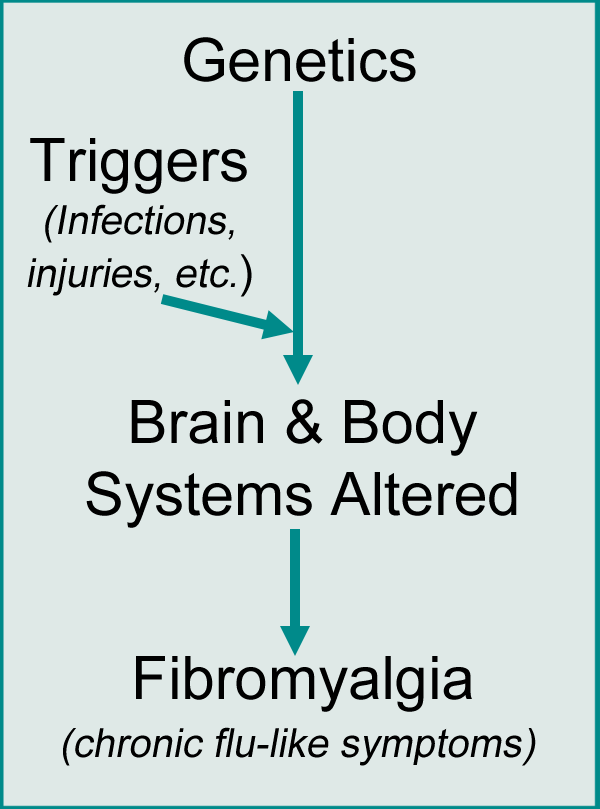
Researchers now believe these widespread disruptions begin when genetics and triggering events alter the body’s control systems.
What Causes Fibromyalgia?
What sets the fibromyalgia wheels in motion? Genetics plays a major role. Blood relatives of fibromyalgia patients are eight times more likely to develop the condition.3
However, genes alone do not appear to cause fibromyalgia. Symptoms usually emerge after a triggering event, such as an infection, injury, another illness, prolonged stress, or trauma.
Researchers know that these events activate immune cells in the nervous system called microglia and impair the body’s ability to fight pain. However, they still do not fully understand how these changes lead to fibromyalgia.
Views on what causes fibromyalgia continue to evolve. Early researchers suspected muscle inflammation, but studies quickly disproved this theory. Later, fibromyalgia was viewed primarily as a disease of the central nervous system.
While that remains partly true, newer research points to a broader picture. For example, transferring serum or gut bacteria from fibromyalgia patients into mice rapidly produces pain symptoms.4,5 These findings suggest that cells and processes outside the nervous system also contribute to the disease.
Today, researchers view fibromyalgia as more than a central nervous system disorder. The digestive, metabolic, hormonal, immune, and other body systems interact with the brain and spinal cord to produce symptoms. Despite affecting so many systems, fibromyalgia remains invisible to standard laboratory testing.
Fibromyalgia is not an inflammatory disease like rheumatoid arthritis, but evidence points to a more subtle form of inflammation. Studies show that many immune cells behave abnormally.6,7
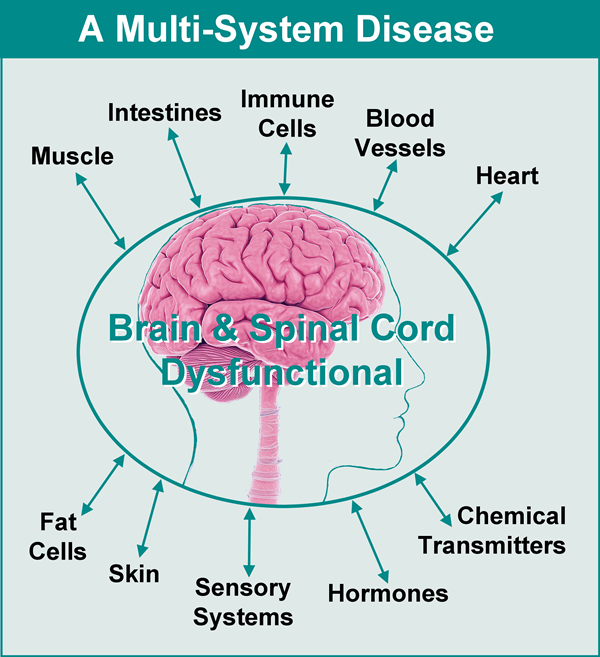
Each of these cells may contribute to symptoms, yet researchers are still working to understand how immune dysfunction interacts with the many other processes involved in the disease. In fact, understanding the immune system’s role in triggering symptom flares is the focus of an AFSA 2024 research award.
Patient Challenges
Fibromyalgia patients face challenges that extend well beyond their symptoms. Some of the most common are summarized below.
Diagnostic Uncertainties – Fibromyalgia is diagnosed by the presence of widespread pain. Unfortunately, fewer than 40 percent of primary care doctors are familiar with the diagnostic criteria.8 A major limitation of the criteria is that diagnosis relies largely on a patient’s report of symptoms. Because there is no objective test, the process can be open to interpretation.
Credibility Issues – Many treating physicians still view fibromyalgia is a psychosocial condition rather than a biological disease. As a result, symptoms may be attributed to depression, poor coping skills, or exaggeration instead of an underlying disease process.
Speaking at the 2024 international pain conference in Amsterdam, Daniel Clauw, M.D., of the University of Michigan challenged these assumptions.9 After following more than 300 children from age 9 onward, he found that widespread pain is the first symptom to appear.
“The depression appears years after the development of widespread pain, rather than causing it,” says Clauw. “The same holds true for pain catastrophizing” (e.g., feeling anxious and out of control). “The sleep disorder comes first, followed by memory problems, pain, and then finally, depression,” says Clauw.
Lack of Funding – The U.S. government spends only 8 cents per patient on quality fibromyalgia research. Admittedly, it spends an additional 20 cents per patient on psychosocial studies that will never lead to effective treatments.10
Ineffective Treatments – Fibromyalgia symptoms arise from many different biological processes, so no single treatment works for everyone. Most medications attempt to correct the central nervous system dysfunction, but they often cause significant side effects.
Alternative therapies can help patients manage symptoms and maintain function, but no treatment currently addresses all the underlying processes that drive fibromyalgia.
Fibromyalgia Quick Facts
Fibromyalgia is a complex multi-system disease that affects far more than muscles and joints. Here are a few key facts to remember:
-
- Affects 3 to 5 percent of the general population.11
- Occurs in people of all ages, including children.
- Men develop fibromyalgia too, although women are diagnosed more often.
- Symptoms are chronic but fluctuate throughout the day.
- Roughly one-quarter of fibromyalgia patients are work-disabled.12
- Four drugs are FDA-approved for fibromyalgia, but European health authorities do not recommend them because of limited effectiveness and significant side effects.
Stay Connected with AFSA – Join our free email newsletter for trusted fibromyalgia updates.
Your support helps move fibromyalgia research forward. AFSA has funded eight studies in the past two years, all focused on diagnostic markers and more effective treatments.
Still have questions? Check our Fibromyalgia FAQs page.
Symptoms | Medications | Alternative Therapies | Muscle Pain Relief | Fibro Friendly Exercises
References for What is Fibromyalgia
- Mueller C, Younger JW, et al. PAIN 164(10)2285-95, 2023. Free Report
- Guler MA, et al. Clin Exp Rheum 39(Suppl 130):S95-S101, 2021. Free Report
- Arnold LM, et al. Arthritis Rheum 50(3):944-952, 2004. Free Report (read only)
- Is Fibro an Autoimmune Disease? Based on a 2022 interview with Andreas Goebel, M.D., Ph.D.
- Targeting the Gut Based on a 2024 interview with Amir Minerbi, M.D., Ph.D.
- Russo M, et al. Pain Physician 27(8):495-506, 2024. Free Report
- Jurado-Priego LN, et al. biomedicines 12(7):1543, 2024. Free Report
- Agarwal A, et al. Medicine 103:31(e39109), 2024. Free Report
- Daniel J Clauw, M.D., Methodological Approaches to the Study of Widespread Pain and Fibromyalgia, IASP Workshop, August 5, 2024.
- Fibromyalgia Research Update, based on the most recent 2023 NIH Report.
- Branco JC, et al. Semin Arthritis Rheum 39(6):448-53, 2010. Abstract
- Fitzcharles MA, et al. J Rheumatol 43(5):931-6, 2016. Abstract