DONATE
Donate

Author: KristinThorson

Marker Maps Fibromyalgia Pain

Treatment & Research News

Marker Maps Fibromyalgia Pain

Home | Treatment & Research News

Abstract painting of whole body to illustrate that the marker maps body-wide fibromyalgia pain.

A marker that maps fibromyalgia pain could validate what patients already know: their pain is widespread and real. One promising molecule is TSPO, short for translocator protein.

Many immune cells carry TSPO on their surface, especially when they respond to inflammation. This makes TSPO act like a flag that researchers can track while imaging the brain and other tissues. Marco Loggia, Ph.D., from Harvard Medical School, studies how TSPO may help detect inflammation-related pain. His work shows that TSPO signals can map painful areas in the brain, spinal cord, and possibly peripheral tissues.*

Neuroinflammation

To grasp why TSPO matters, it helps to first understand neuroinflammation. The term means ongoing inflammation in the brain and spinal cord. Glial cells drive much of this process. These support cells constantly watch for infection, injury, or other threats. In a healthy nervous system, glial cells respond quickly, help clean up the problem, and then return to their normal watchful state.

“Sometimes these immune responses become problematic,” says Loggia. “Activated glial cells continue unchecked even after the initial threat is resolved. They overstay their welcome and become harmful.” When this happens, glial cells may keep the nervous system inflamed. Researchers call this chronic neuroinflammation and have linked it to diseases such as Alzheimer’s, Parkinson’s, and schizophrenia.

Seeing TSPO Signals

Sampling brain tissue is too invasive. Instead, researchers can use PET, short for positron emission tomography, to image the brain. During PET imaging, doctors inject a small amount of radioactive tracer that attaches to TSPO and creates a signal on the scan.

Healthy brains show very little TSPO. But when neuroinflammation activates glial cells, TSPO levels rise and appear as “hot spots” on PET scans.

Loggia used PET to track TSPO in painful conditions linked to neuroinflammation, including fibromyalgia, low back pain, and migraines. These TSPO hot spots point to activated glial cells, which may help drive persistent pain. The location of the TSPO signal also tells researchers something important: it can show where the body hurts.

Mapping Pain Areas

Loggia’s first PET studies with a TSPO tracer focused on people with chronic back pain. Some patients showed a strong TSPO signal in the cortex, but others did not. Loggia suspected leg pain might explain the difference.
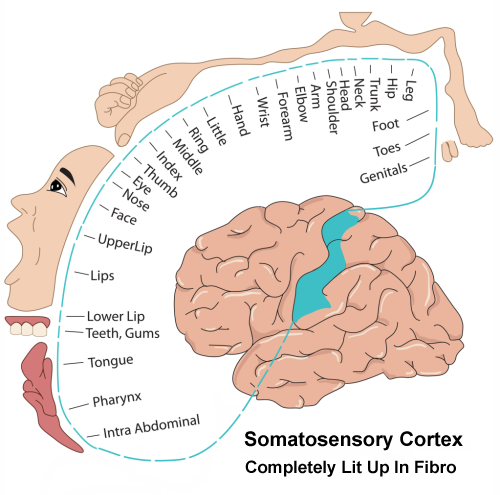
Diagram of the somatosensory cortex to show area that is completely lit up by the TSPO marker that maps fibromyalgia pain.

“Comparing patients with leg pain versus spinal pain, those with added leg pain showed a greater signal in the cortex,” says Loggia. He also measured each patient’s “fibromyalgia-like” score. The higher the score—the more painful body areas reported—the stronger the signal, especially in the somatosensory cortex.1

“The somatosensory cortex contains a full representation of the body,” says Loggia. “Different parts of this cortical region process sensory inputs from different body parts.” In low back pain patients, he says, “We saw a TSPO signal elevation in the cortex that matches the regional representation of back and leg pain.”

Migraines showed a similar pattern. The TSPO signal appeared in the cortical area that represents the face and head.

For fibromyalgia, Loggia says, “We should see the whole somatosensory cortex light up because patients report widespread pain. And that is what we see.”2 An AFSA-funded study later replicated this finding.

No Sex Differences

TSPO appears on immune cells, and the immune system can work differently in men and women. However, Loggia did not find sex differences in his low back pain studies.

Spinal Cord & DRGs

So far, these studies have focused on the brain. Can TSPO also detect pain-related inflammation in the spinal cord? Loggia showed that it can. In people with back pain, TSPO detected inflammation in the spinal cord and nearby structures, including the nerve roots and dorsal root ganglia, or DRGs.3

DRGs contain nerve cell bodies just before the nerves enter the spinal cord. Although DRGs sit outside the cord, TSPO-producing glial cells surround them. This matters for fibromyalgia because researchers suspect the DRGs may help amplify pain signals.

TSPO in Body Tissues

“Wouldn’t it be wonderful to use the same marker to image inflammation in the brain, spinal cord, and peripheral tissues like joints?” asks Loggia. Since many immune cells produce TSPO, it might work as a marker outside the nervous system too.

Loggia tested this idea in people with knee osteoarthritis. He compared PET scans from people with and without knee pain. Like the “hot spots” seen in the brain, TSPO signals appeared strongly in painful knees with arthritis. The signal also showed whether arthritis affected one or both knees.

Knee osteoarthritis is not fibromyalgia, but Loggia’s study found two points that may matter for chronic pain:

  • Stronger TSPO signals matched higher levels of knee pain.
  • TSPO signal strength also matched higher levels of several immune substances in the blood.

Together, these findings suggest that TSPO may help detect pain and inflammation in body tissues, although researchers still need more studies.

Tracking Treatment Response

If TSPO can detect pain and inflammation, it may also help researchers measure treatment response. Fibromyalgia studies often rely on symptom reports, which matter because patients know their pain best. But researchers also need objective tools that show whether a treatment changes pain-related inflammation.
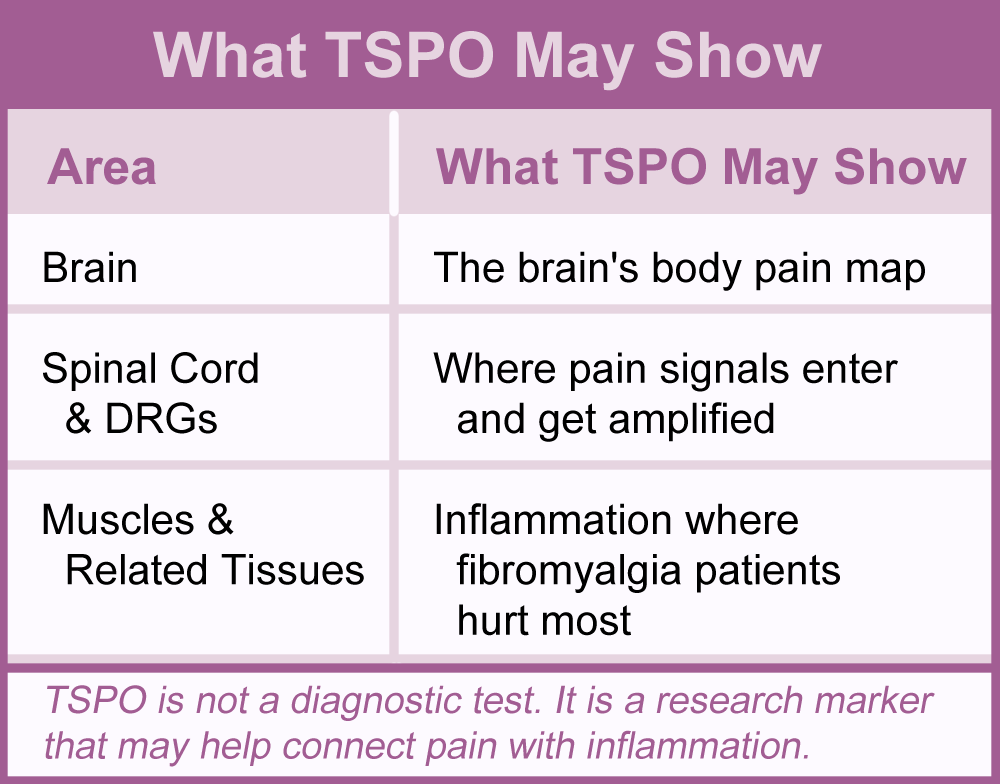
Table shows which fibromyalgia pain areas can be revealed by the TSPO pain marker.

Knee osteoarthritis offers one example. Total knee replacement removes the damaged joint, yet 30 percent of patients continue to have pain. Loggia found that TSPO signals in the brain before surgery helped predict who still had knee pain one year later.

The pre-surgery signal was stronger in patients who still had knee pain after one year. “This suggests that the TSPO signal we are measuring is not an epiphenomenon,” says Loggia. “It appears to have something to do with the establishment or maintenance of persistent pain.”

High-intensity signals in the sensory cortex of knee arthritis patients reflected the “fibromyalgia-like” nature of their pain. This pattern matters because fibromyalgia also involves widespread pain and increased TSPO signals in the sensory cortex. As researchers develop new fibromyalgia treatments, they might someday put them to the “TSPO test” to see whether they quiet pain-related inflammation.

Stay current on fibromyalgia treatment and research news.
Join AFSA’s free membership list for patient-friendly updates.

Future Markers

Loggia highlights TSPO as a marker for chronic pain and neuroinflammation. However, PET imaging with TSPO requires a radioactive tracer, so researchers continue to look for easier tools.

“Many groups around the world are looking at the concentration of brain metabolites believed to be linked to glial cell activity,” says Loggia. Researchers are studying these metabolites in fibromyalgia, but they still need to compare them with TSPO in the same patients. For now, Loggia concludes, “The use of TSPO to image peripheral and central nervous system inflammation (and pain) is opening new doors.”

Mapping Pain Beyond the Brain

AFSA recently funded Loggia to use TSPO imaging in a new way. His team will look for inflammation outside the brain in areas where fibromyalgia patients hurt most, such as their muscles. The goal is not to turn whole-body PET into a diagnostic test. Instead, this study will test whether painful body areas also carry stronger TSPO signals. If they do, this fibromyalgia pain marker could help link immune activity and inflammation to patients’ pain.

TSPO appears on many immune cells, not just glial cells. When inflammation activates these cells, they may produce more TSPO. If the study finds stronger TSPO signals in painful muscles or other tissues, it could help validate the body-wide pain patients describe. It could also guide future treatment research.

Help move fibromyalgia research forward.
AFSA-funded studies like Dr. Loggia’s TSPO project may help validate pain patients feel but others cannot see. Your donation helps support more research toward better answers and treatments.

Donate Now

More About Glial Cells

While Loggia describes TSPO as a pain-mapping marker on immune cells, including glial cells, it helps to know what these cells are doing in fibromyalgia.

Glial Cells in Your Brain – These cells can be your neuron’s best friend, but research shows this is not the case for fibromyalgia patients. Find out what they are doing and what can be done to get them to behave.

Glia Around Your DRG – These cells can control your dorsal root ganglia (DRG) so the signal entering your spinal cord is amplified. Research shows your glia are under attack in fibromyalgia.

Symptoms  |  Medications | Alternative Therapies |  Muscle Pain Relief  |  Fibro Friendly Exercises   

1. Alshelh Z, Loggia ML, et al. Brain 145(3):1098-1110, 2022. Free Article
2. Albrecht DS, Loggia ML, et al. Brain Behav Immun 75:72-83, 2019. Free Article
3. Albrecht DS, Loggia ML, et al. Pain 159(5)968-977, 2018. Free Article

* Neuroinflammation: Does it have a role in human chronic pain? by Marco Loggia, Ph.D., presented at the International Association for the Study of Pain (IASP) World Congress, August 5, 2024.

Continue reading

Targeting the Gut

Treatment & Research News

Targeting the Gut
for treating fibromyalgia

Home | Treatment & Research News

Photo of person taking a capsule for treating the gut microbiota in fibromyalgia.

Your gut bacteria or microbiota form a living community that communicates with your brain. In fact, your microbiota exert significant control over your overall health. Five years ago, Amir Minerbi, M.D., Ph.D., of Israel published a groundbreaking study showing microbiota abnormalities in fibromyalgia.1 Today, treating the gut microbiota in fibromyalgia represents a novel approach.

If studying your gut microbes seems off topic for fibromyalgia, see our article on Gut Influences. Ordinarily, the intestinal bacteria and central nervous system have a “healthy” relationship. But in people with fibromyalgia, the bugs living in the gut are different from healthy, pain-free people. New research by Minerbi’s team reveals that the altered microbiota are linked to fibromyalgia symptoms.2

Transferring Fibro to Mice

Transplanting the microbiota from fibromyalgia patients into the digestive tract of mice causes the animals to become pain sensitive. The process is called fecal microbiota transplantation (FMT).  Alterations in the mouse’s microbiota is linked to increased pain sensitivity during the first two weeks. Not only does the microbiota of the mice mimic that of the fibromyalgia patients, but the mice also develop fatigue. FMT from healthy people does not impact the mouse’s symptoms or microbiota.

Pain Precedes Depression

All too often, fibromyalgia is wrongly dismissed as depression or anxiety. The medical community calls these “affective traits.” Understandably, affective traits negatively impact a person’s health and contribute to reduced pain thresholds. However, it is frustrating for patients to be told that their fibromyalgia is caused by their state of mind.

Pull quote by researcher that fibromyalgia is not depression.

To set the record straight, Minerbi selected fibromyalgia patients who did not have symptoms of depression or anxiety. “It was important to show that pain hypersensitivity is not mediated by affective traits,” says Minerbi. “The fact that pain is detectable in the mice days following FMT but depressive signs arise months later is a hint that pain precedes depression.” As a result, treating gut microbiota in fibromyalgia may reduce pain and prevent the mood disorders.

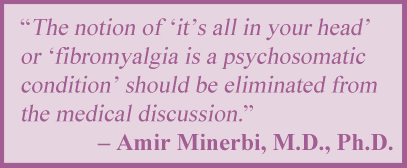
“The notion of ‘it’s all in your head’ or ‘fibromyalgia is a psychosomatic condition’ should be eliminated from the medical discussion,” says Minerbi. “Patients, families and clinicians need to know this.”

Altered Metabolism

Gut microbes can influence the production of pain-enhancing amino acids like glutamate and alter fat metabolism. The bacteria can also increase the production of bile acids that cause pain, rather than relieve it. These unwanted effects are well-documented in people with fibromyalgia.  And it turns out, the mice receiving FMT develop the same metabolic abnormalities as the patients. Quite possibly, treating the gut microbiota in fibromyalgia patients can decrease glutamate and lead to reduced pain.

The mice didn’t just have increased glutamate in their blood, the concentration of this pain transmitter was also elevated in the central nervous system. This goes to show that transferring microbiota into the gut significantly impacts brain function.

Immune Changes

Your intestines are lined with immune cells. In addition, lymph and a variety of immune cells surround your digestive tract. If the microbiota in the gut is altered in an unhealthy way, the immune system might become actively defensive. This angle was explored by Minerbi’s colleague, Arkady Khoutorsky, DVM, Ph.D.*

Looking at the numbers of immune cells in the blood of mice, Khoutorsky found the memory B cells were nearly depleted. Memory B cells help your immune system remember prior exposures of potentially threatening agents. If the agent enters your body again, your memory B cells pump out antibodies to neutralize the threat. Khoutorsky did another test that showed increased activation of the immune system. 

People with fibromyalgia have activated immune cells in their brain called microglia. Minerbi found these same cells to be on guard in the brains of mice exposed to fibromyalgia FMT. To measure the microglia’s role, he blocked their activation with a medication prior to the FMT. The ability of fibromyalgia microbiota to produce pain sensitivity was greatly reduced. “These results indicate that the development of pain after fibromyalgia FMT is partially mediated by the microglia.”

The Neurons

Most fibromyalgia patients will say their skin burns, their muscles ache, and their brain function is dulled (e.g., fibrofog). It’s hard to believe that the far-reaching effects of fibromyalgia are solely due to malfunctions in the brain and spinal cord. Conversely, if the muscles were the source of disease, how would one explain the common symptoms of fibrofog and sleep disorder?

Prior studies show a misbehaving immune system targets the dorsal root ganglia (DRG) to amplify pain transmissions. But other neurons are also affected. “The DRG is an attractive target,” says Minerbi. “But in our study, there are changes in all levels of the pain-signaling pathways. The peripheral small nerve fibers, the DRG, the spinal cord, and the cortical structures in the brain are all involved.” At least, this is what Minerbi found in the mice when he looked at the effects of FMT from fibromyalgia patients. So, the neurons at all levels of the nervous system may be contributing to your symptoms. 

But how can you relate this finding to the bugs growing in your intestines? Disruption of your gut microbiota leads to activation of your immune system. After all, the immune cells lining your intestinal tract are programmed to protect you from foodborne pathogens. If the bacteria in your gut changes composition, they can also set off alarms targeting all levels of your nervous system. So, treating the gut microbiota in fibromyalgia patients can mute the immune system and reduce pain signals transmitted by the neurons.

FMT in Fibro Patients

A small trial of FMT from healthy subjects to fibromyalgia patients led to a 30 percent reduction in pain. But just doing the FMT alone did not work. Patients had to be given antibiotics before the ten-week trial (five transfers every two weeks).

“The microbiota in the gut is a stable environment,” says Minerbi, “and it’s resilient to transient perturbations. The amount of bacteria we give in FMT is many orders of magnitude smaller than that of the established microbiota in the gut.” So, antibiotics are given to clear out the existing bacteria and allow the transplanted bacteria to take hold.

Based on the success of this small trial, a large placebo-controlled study is underway. Minerbi’s team will be looking at which bacteria improve the most, in addition to alterations in the metabolic and immune system variables.

Researcher quote on identifying bacterial species for treating gut microbiota in fibromyalgia patients.

“We hope this will help explain why certain fibromyalgia patients respond better than others,” says Minerbi. “We also want to identify the biological mechanisms responsible for symptom improvements.”

Designer Treatments

Even if FMT turns you off, it provides much-needed answers from a research perspective. Perhaps the greatest downside of FMT is that it cannot be commercialized. Minerbi points out that some companies already have FDA-approval for microbiota-based therapeutics. Basically, these companies aim to develop specially formulated probiotics to treat illnesses like fibromyalgia.                               

“We aim to identify the bacterial species that are critical for effective fibromyalgia treatment out of the hundreds that are given during FMT,” says Minerbi. “Then these species can be developed into future therapy for the disease. Since fibromyalgia is a diverse condition, there may need to be more than one formulation.” Indeed, treating the gut microbiota in fibromyalgia patients may be tailored based on one’s microbial composition.

In the Meantime …

If you are tempted to purchase multiple probiotics to tame your fibromyalgia symptoms, press the pause button. Hundreds of bacterial species live in the gut but only a few are contributing to your symptoms. On the other hand, Minerbi says that the probiotics on the market do not contain any species suspected to be involved in the disease. You are also up against the fact that your existing microbiota community is resilient to change.

It’s frustrating to know that a disruption of your microbiota is likely linked to your symptoms, but you can’t just correct it with probiotics. Until designer treatments become available, Minerbi recommends a low-sugar and gluten-free diet, exercise regularly, and get plenty of sleep. See Diet & Nutrition for assistance. These measures are known to help maintain a healthy community of gut bacteria.

Research takes time, and this is frustrating to hear. But keep in mind that seven years ago the microbiota was not known to be involved in fibromyalgia. “The results are promising, so there is hope on the horizon,” says Minerbi.

AFSA funded six projects in the past two years, and one award went to Dr. Minerbi to expand his amazing research.  Help us fund more studies in 2026.

Donate Today

Stay Current on Treatments & Research News. Sign up for a Free Membership today!

Symptoms  |  Medications | Alternative Therapies |  Muscle Pain Relief  |  Fibro Friendly Exercises   

*  Minerbi’s team of collaborators include Yoram Shir, M.D., Arkady Khoutorsky, DVM, Ph.D., and Emmanuel Gonzales, Ph.D., of McGill University in Canada and Nicholas Bremerton, Ph.D., of University College in Dublin.

  1. Minerbi A, et al. PAIN 160:2589-2602, 2019. Free Abstract
  2. Cai W, Shir Y, Minerbi A, Khoutorsky A, et al. BioRxiv Oct 28, 2023. Free Report

Continue reading